
Business Diner Tools:


Blogs
Business Dining Programs vs. Traditional Restaurant Rewards
Business dining programs help companies turn eligible meal spending into organizational savings and visibility, while traditional restaurant rewards primarily give individual diners perks for their purchases. Both can reward the person at the table, but only a business dining program is designed around the employer’s dining spend.
That distinction matters when meals are part of doing business. A client lunch, a team catering order, and dinner on the road may all hit the same budget without anyone seeing the bigger picture. When comparing Business Dining Programs vs. Traditional Restaurant Rewards, start with a practical question: Are you trying to reward a diner, manage company spending, or do both?
What Is a Business Dining Program?
A business dining program connects employers and their employees with a network of participating restaurants. The goal is to make business meals work harder for everyone involved: companies gain savings and spending visibility, employees find places to dine, and restaurants reach business customers.
In a corporate card–based model, employees pay for eligible meals with their company cards. Transaction data identifies spending at participating restaurants, helping determine the company’s rebate under its program agreement. Some programs also offer personal rewards for eligible employees.
Business dining reaches beyond the occasional client dinner. It can include travel meals, meeting catering, and private events, depending on program eligibility. Rather than asking employees to chase discounts, the program adds value to dining the company already pays for. Expense policies still apply.
What Are Traditional Restaurant Rewards?
Traditional restaurant rewards are loyalty programs that encourage customers to return. A diner joins, makes qualifying purchases, and earns something back, such as points, a discount, or a complimentary menu item.
These programs usually center on an individual’s relationship with a restaurant or brand. Some payment cards also offer dining rewards through the card issuer. Benefits and earning rules vary, but the basic idea stays the same: reward a purchase today to encourage another visit tomorrow.
Restaurant Apps and Punch Cards
A restaurant app or punch card keeps loyalty simple: identify yourself, make an eligible purchase, and build toward a reward. An app might require a phone number, account scan, or online order. A punch card might track drinks or visits.
These tools are useful for familiar routines, like coffee near the office. They generally track activity with that restaurant, not an employer’s dining spend across a broader network of restaurants.
Points and Discounts
Points-based programs assign value to qualifying purchases. Diners might earn points per dollar, then exchange them for a discount or another benefit. Some restaurants add bonus offers for specific days, menu items, or spending thresholds.
The details deserve a look. Points may expire, certain purchases may not qualify, and redemption may require a minimum balance. A generous-looking offer only helps when the diner can actually use it on a future visit.
Free Items and Visit-Based Rewards
Not every loyalty program revolves around dollars spent. Some count qualifying visits or purchases toward a free item. Think of a lunch spot that rewards a customer after a set number of eligible orders.
These offers can be easy to understand and appealing to regulars. However, minimum purchase amounts, exclusions, and expiration dates can affect their value. For a traveler who rarely returns, a visit-based reward may never become useful.
Credit Card Dining Rewards
Credit card dining rewards come from a card issuer rather than the restaurant itself. An eligible dining purchase may earn cash back, points, or miles, depending on the card’s terms and how the merchant is categorized.
With company cards, the employer’s agreement determines who receives those rewards. Employees should never assume that paying for a business meal earns them personal points. Card benefits and restaurant loyalty benefits are separate arrangements.
Business Dining Programs vs. Traditional Restaurant Rewards at a Glance
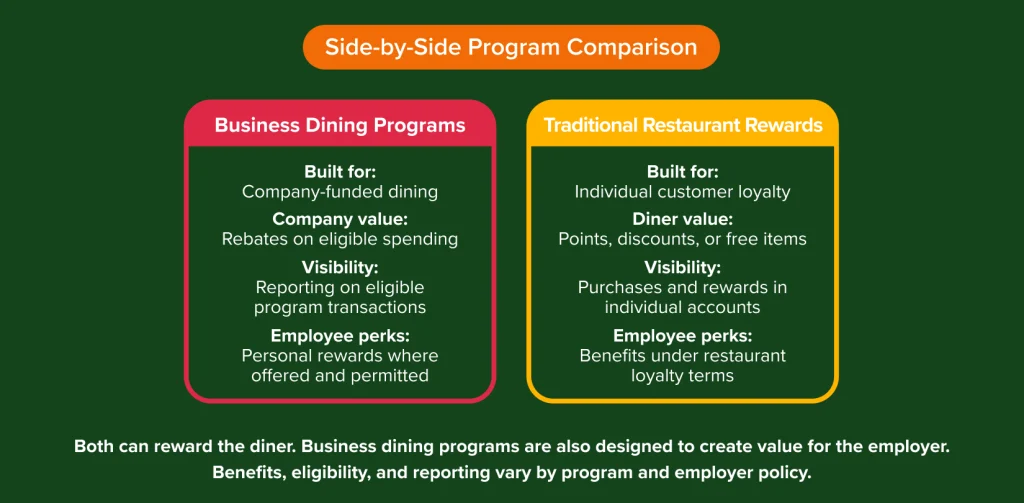
The clearest distinction is who the program serves. This Business Dining Programs vs. Traditional Restaurant Rewards comparison shows how that difference affects everyday use. Specific features depend on the provider, restaurant, card issuer, and employer policy.
| Comparison | Business dining programs | Traditional restaurant rewards |
| Primary purpose | Manage company dining value | Encourage individual customer loyalty |
| Who joins | Employer establishes program; employee eligibility varies | Diner enrolls with restaurant or issuer |
| Payment | Eligible business spending, often corporate cards | Qualifying payment under loyalty terms |
| Company savings | Rebates on qualifying network spending | Not typically designed for employer savings |
| Employee benefit | Personal rewards where available and permitted | Points, discounts, free items, or miles |
| Restaurant benefit | Access to business diners and corporate demand | Repeat visits from enrolled customers |
| Tracking | Eligible corporate transactions matched to participating restaurants | Member purchases, visits, or qualifying card transactions |
| Employer reporting | Program-level visibility, subject to available transaction data | Generally no consolidated employer reporting |
How Business Dining Programs Work
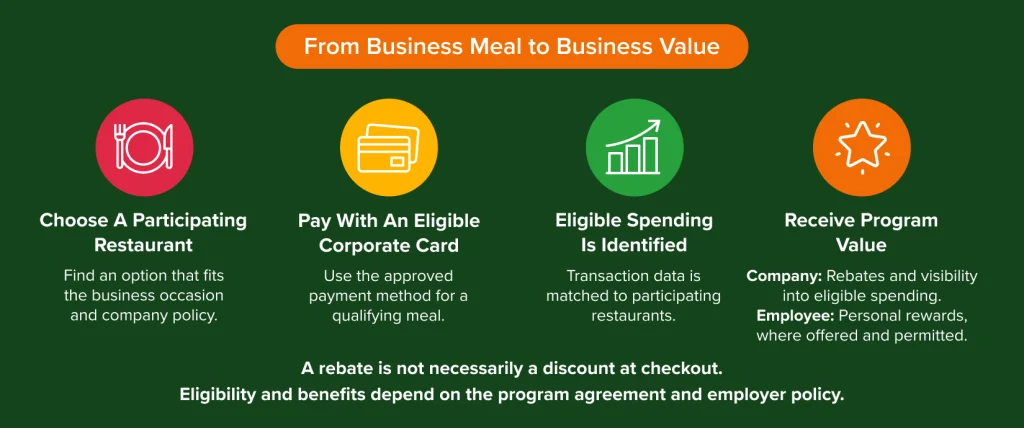
The process connects company participation, restaurant choice, and eligible payment data. Employees keep dining for business, while the program identifies qualifying purchases and applies the benefits available under the agreement.
Who Participates
Three groups make the model work: employers, business diners, and participating restaurants. Employers establish the program and communicate how it fits their travel and expense policies. Employees choose restaurants for eligible meals, whether they are meeting a client or ordering lunch for a team.
Restaurants join the network to reach those diners. Participation can include independent operators and national brands, giving employees options across locations, cuisines, and price points. Available coverage depends on the provider’s network.
How Business Dining Spend Is Tracked
In a corporate card–based program, transaction data from an agreed card feed is matched with participating restaurants. That match identifies eligible spending without requiring diners to present a coupon or restaurants to change their checkout routine.
The details matter. Card coverage, merchant identification, and transaction eligibility determine what the program can recognize. Purchases routed through third-party services may be treated differently, so employees should check the rules before ordering.
Transaction tracking also has limits. A card record can help show where and how much someone spent, but it does not necessarily include itemized meals, attendees, or the business purpose.
How Companies and Employees Receive Value
Companies receive value through rebates on qualifying dining spend and better visibility into participating transactions. Those rebates reduce the effective cost of eligible meals; they are not necessarily discounts applied to the restaurant bill.
Employees may receive personal rewards when the program offers them and their employer permits participation. Restaurant search tools can also make it easier to find a suitable place near a meeting, hotel, or office.
These benefits serve different needs. Finance teams want measurable savings, while diners want a straightforward experience. A useful program supports both without making every business meal feel like another administrative task to finish.
How Traditional Restaurant Rewards Work
Traditional rewards follow a familiar cycle: join, make a qualifying purchase, and earn a benefit. The restaurant or card issuer sets the rules for earning, redemption, exclusions, and reward expiration.
How Customers Earn Rewards
Customers usually earn rewards by identifying their loyalty account when they buy. That might mean scanning an app, entering a phone number, ordering through a brand’s website, or using an eligible linked card.
The earning method varies. Some programs count dollars, others count visits, and some reward specific purchases. Taxes, tips, alcohol, or third-party orders may be excluded. For employees dining on company business, the purchase must also comply with employer policy, regardless of how attractive the loyalty offer looks.
How Customers Redeem Rewards
Redemption might happen in an app, at checkout, or through an account credit. A diner could apply points to an eligible order, select a complimentary item, or activate an offer before paying.
Availability is not always immediate. Programs may require a minimum balance, limit which locations accept rewards, or restrict combining promotions. Employees should also understand how their company handles discounts and personal benefits on business purchases. When a reward changes the amount paid, the expense record should reflect the actual charge.
How Restaurants Encourage Repeat Visits
Restaurants use rewards to give guests a reason to choose them again. Welcome offers encourage a first visit, while progress toward a reward can make a return trip more appealing. Personalized offers and reminders can help a restaurant stay on a customer’s radar.
That approach works especially well when people have a routine. The neighborhood lunch customer may return often enough to redeem rewards. A business traveler passing through once may care more about location, availability, and an easy payment experience.
Six Areas Where They Differ
The differences become clearer when you follow the meal from signup to reporting. Here are six practical considerations for companies deciding how to approach business dining and employee reward opportunities.
1. Who Signs Up
A business dining program starts with the employer. The company establishes participation, confirms eligible payment arrangements, and explains how employees should use the program. Depending on the offering, diners may also create an account to access personal rewards or other features.
Traditional restaurant loyalty usually starts with the individual. Someone joins a restaurant’s program because they like the food, visit often, or want an offer.
That distinction affects reach. An employer-led program can support a companywide dining approach, while individual loyalty accounts typically remain separate. Employees collecting rewards do not, by themselves, give their employer a coordinated dining program.
2. Who Pays for the Dining
Business dining programs are built around meals funded by an organization. In a corporate card–based model, the employee pays with an eligible company card, and qualifying transactions are recognized through the program. The business purpose and expense policy still govern what can be purchased.
Traditional restaurant rewards do not necessarily distinguish between personal and business occasions. A qualifying purchase may earn rewards either way, subject to program terms.
For employers, that difference matters. A loyalty account tells you who earned a benefit, not necessarily who funded the meal. Payment eligibility and reimbursement rules need their own clear, consistent guidance.
3. Perks for Employees
Traditional rewards put the personal benefit front and center: a discount, a free item, or points toward a future purchase. Employees may appreciate those perks, particularly at restaurants they already visit regularly.
Some business dining programs also offer personal rewards, but within a structure that creates value for the employer. Employees can choose participating restaurants and earn eligible benefits while the company receives its own program value.
Neither approach should push someone to overspend or choose an unsuitable venue. The best perk is one that fits the business need, stays within policy, and does not add unnecessary work to the meal.
4. What Restaurants Get Out of It
Traditional loyalty programs help restaurants strengthen relationships with individual guests. They can encourage repeat visits, support targeted offers, and keep regular customers engaged with the brand.
Business dining programs add a different route to demand: access to employees whose organizations are paying for business meals. Those occasions can include client lunches, travel dinners, catering orders, and private events.
The restaurant is not simply offering a consumer coupon. It is investing in access to business customers. Whether the economics work depends on the program’s fees, the business it generates, and the restaurant’s own costs, capacity, and goals for profitable growth.
5. Savings for the Company
An employee earning a free appetizer does not automatically lower the company’s dining costs. Traditional loyalty benefits often belong to the individual account, and the employer may have no way to capture or measure that value.
A business dining program is designed to return value to the organization through rebates on eligible spending. Results depend on participation, restaurant coverage, qualifying transactions, and the company’s program agreement.
Rebates should complement sound expense management, not replace it. A meal outside policy is not a better purchase simply because it qualifies. Companies still need sensible budgets, clear approval rules, and appropriate restaurant choices.
6. Reporting
Traditional restaurant loyalty reporting generally lives inside the diner’s account or the restaurant’s systems. It may show points, purchases, or offers, but it typically does not give an employer a consolidated view across restaurant brands.
A business dining program can provide visibility into eligible dining transactions, helping companies understand program use and the value generated. Reporting capabilities vary by provider and available payment data.
Companies should ask what is included, how often information updates, and which transactions are excluded. Program reporting does not automatically replace expense reporting: receipts, attendee details, and business purposes may still need to be documented elsewhere.
Can Employees Earn Both?
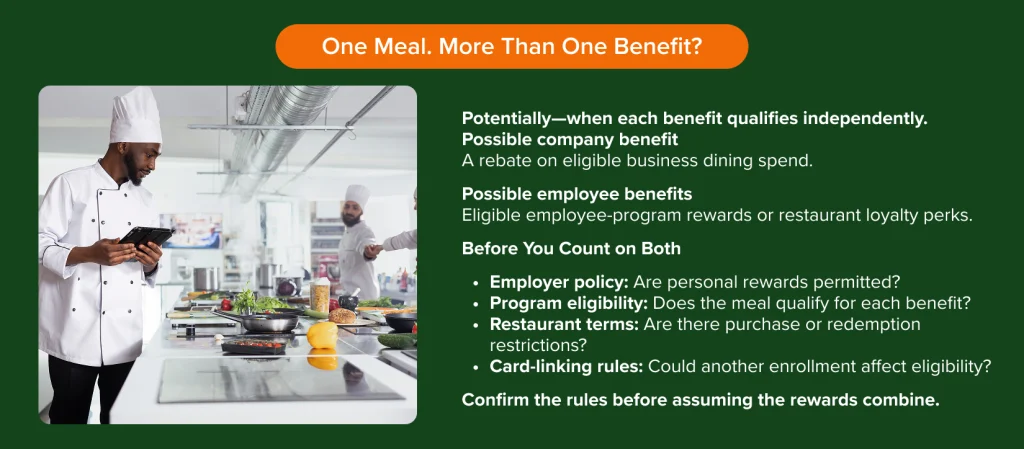
Sometimes, yes. A qualifying business meal may earn a company rebate through a business dining program and personal benefits through an eligible employee rewards offering or restaurant loyalty account. But combining benefits is not automatic.
Employees need to check employer policy, restaurant loyalty terms, and any card-linked restrictions. Some offers cannot be combined, and some card-linked programs may conflict when the same payment card is enrolled elsewhere. Card issuer rewards also follow their own ownership and eligibility rules.
For example, a traveler might choose a participating restaurant, pay with an approved corporate card, and identify a restaurant loyalty account if permitted. The meal must qualify independently for each benefit. The practical rule is simple: confirm eligibility before assuming that one transaction will earn every available reward.
Which Dining Approach Works for Your Company?
The right choice depends on whose needs you are solving. Look at dining volume, restaurant coverage, payment methods, and reporting requirements before deciding whether personal rewards alone cover the job.
When a Business Dining Program Makes Sense
A business dining program is worth considering when employees regularly buy meals for travel, client meetings, or team events. It is especially relevant when the company wants value from spending that already happens, rather than relying on individual diners to find discounts.
Start with practical questions. Does the restaurant network cover your employees’ destinations? Can the program recognize your payment arrangements? What savings and reporting are available?
A strong fit supports existing expense policies and gives employees useful choices without asking them to change how they work unnecessarily.
When Traditional Rewards Do the Job
Traditional rewards may be enough when the goal is simply to give individual diners benefits at restaurants they already enjoy. For an employee who buys lunch personally or visits the same coffee shop daily, a straightforward loyalty account can be useful.
They may also be the only relevant option where business dining is infrequent or a corporate program does not support the company’s payment setup. Just keep expectations clear: personal loyalty benefits are not a substitute for employer-level savings, coordinated dining guidance, or consolidated visibility into business meal spending.
Bring a Business Dining Program to Your Team With Dinova
Business Dining Programs vs. Traditional Restaurant Rewards is not an either-or decision. It is about giving business meals a bigger job.
At Dinova, we make business meals count. Our preferred business dining program connects companies with more than 24,000 restaurants across the U.S. and Canada. Eligible corporate card transactions help deliver company rebates and spend visibility, while myDinova Rewards offers eligible diners personal rewards.
Ready to put your dining spend to work? Connect with Dinova to explore restaurant coverage, payment eligibility, and a program that fits your team’s business dining needs.
FAQs
What’s the difference between a business dining program and restaurant rewards?
A business dining program is designed to create value from company-funded meals through benefits such as rebates and spend visibility. Traditional restaurant rewards primarily encourage individual diners to return through points, discounts, or free items. Some business dining programs also offer employee rewards, so the benefits are not mutually exclusive.
Can business travelers earn airline miles on company-paid meals?
Sometimes. An eligible card or separate dining rewards offer may award airline miles, but company payment does not guarantee personal earning. Eligibility depends on the issuer’s or program’s rules, who owns the rewards, and employer policy. Travelers should confirm those details before expecting miles from a company-funded meal purchase.
Can employees earn both business dining and restaurant rewards?
Potentially, if the meal qualifies under both programs and the employer allows it. Employees should check restaurant loyalty rules, business dining eligibility, and any card-linking restrictions. Some offers cannot be combined. A company rebate and a personal reward may coexist, but neither benefit should be assumed without checking the terms.
Do restaurant rewards programs give employers any reporting?
Traditional restaurant loyalty programs generally provide information to the member, not consolidated dining reports to an employer. Separate corporate offerings may differ. Card or expense systems can show company spending independently, but that visibility does not come from the employee’s restaurant loyalty account or automatically include its reward activity data.
How does a business dining program save a company money?
A business dining program can return rebates on eligible purchases at participating restaurants, lowering the effective cost of those meals. Savings depend on qualifying spend, program terms, and employee participation. Employees may still pay full price at checkout; the company receives its program value separately under the agreed rebate arrangement.
Are business dining programs only for large companies?
No. Business dining programs can serve smaller and midsize businesses as well as large corporations and government agencies. Dinova works with organizations across those categories. Fit depends on factors such as eligible payment arrangements, dining activity, and restaurant coverage. Companies should ask about current participation requirements rather than assuming eligibility.