


Blogs
Restaurant Marketing: Proven Strategies to Attract More Customers
A restaurant can serve an unforgettable meal and still have empty tables on a Tuesday afternoon. Good food matters, of course. So do service and atmosphere. But none of them can influence a guest who never hears about the restaurant in the first place.
That is the job of restaurant marketing: helping the right people discover a restaurant, giving them a reason to choose it, and making it easy to take the next step. Sometimes that next step is a reservation. It could also be a direct order, a private dining inquiry, or simply remembering the restaurant when Friday night rolls around.
Operators do not need to chase every platform or promotion to make that happen. They need a clear message, a reliable local presence, and a practical way to tell which efforts are actually bringing people through the door.
What Makes a Successful Restaurant Marketing Strategy?
A successful restaurant marketing strategy begins with a clear understanding of the restaurant, its customers, and the experience it offers. Before selecting tactics or channels, operators should be able to answer a few fundamental questions:
- Who are the restaurant’s highest-value customers?
- What occasions bring them in, such as weekday lunches, celebrations, business meals, or weekend takeout?
- What makes the restaurant meaningfully different from nearby competitors?
- Which menu items, dayparts, or locations need additional demand?
- What action should a potential customer take after seeing the restaurant’s marketing?
These answers create the foundation for more focused decisions. A neighborhood café looking to increase weekday breakfast traffic will require a different approach than an upscale restaurant seeking private dining reservations or a multi-location brand trying to build awareness in a new market.
Strong restaurant marketing also connects brand consistency with measurable business goals. The restaurant’s voice, imagery, menu positioning, and guest experience should feel recognizable across its website, listings, social channels, and in-store materials. At the same time, each campaign should support a specific result, such as more reservations, larger direct-order volume, increased loyalty enrollment, or stronger traffic during a particular daypart.
Marketing becomes more effective when operators treat it as an ongoing cycle: set a goal, choose the appropriate audience and channel, launch the campaign, review the results, and adjust the next effort based on what worked.
How to Increase Your Restaurant’s Local Visibility
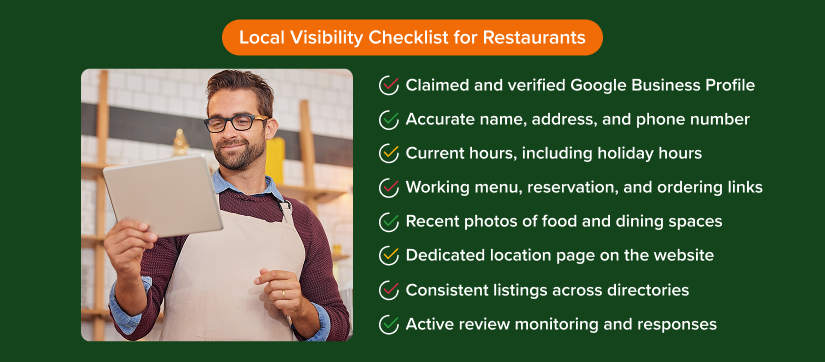
Restaurant discovery usually happens close to the moment of decision. Someone searches for lunch near the office, checks which restaurants are open after an event, or looks for a place that can accommodate a group. Being visible in those moments matters because the customer is not casually browsing. They are trying to decide where to eat.
Optimize Your Google Business Profile
For many guests, a Google Business Profile is the first real interaction with a restaurant. They may see the hours, menu, photos, reviews, and reservation options without visiting the restaurant’s website at all. A complete profile can move that person toward a visit. An outdated one can send them somewhere else.
Each location should be claimed and verified. Check the restaurant name, address, phone number, primary category, regular hours, holiday hours, menu link, website, and reservation or ordering links. If the restaurant offers patio seating, takeout, private dining, or other features guests routinely ask about, include them where the profile allows.
Photos deserve more attention than they often receive. A potential guest wants to see the food, but they may also be judging whether the dining room works for a client meeting, whether the bar feels right for happy hour, or whether the entrance will be easy to spot from the street. Recent, high-quality images help answer those questions before they become reasons to hesitate.
Assign someone to review the profile regularly, especially before holidays or seasonal hour changes. A special menu will not help much if the link leads to last season’s PDF.
Improve Local SEO Rankings
Local search engine optimization helps a restaurant appear when nearby customers search for terms connected to its cuisine, location, or dining occasion. Instead of targeting only broad phrases such as “best restaurant,” operators can build pages around the specific searches their customers are likely to make, such as “Italian restaurant in downtown Nashville,” “private dining near the convention center,” or “business lunch in Chicago.”
Each location should have a dedicated webpage with accurate contact information, hours, menu details, neighborhood references, and relevant amenities. Restaurants can also create useful content around the experiences they offer, including catering, group dining, happy hour, seasonal menus, or event hosting.
Technical details matter, too. A mobile-friendly website, fast load times, clear page titles, descriptive copy, and consistent business information make it easier for both customers and search engines to understand the restaurant.
Manage Online Reviews and Reputation
Reviews influence both visibility and customer confidence. Restaurants should make it easy for satisfied guests to share feedback through a follow-up email, text message, receipt prompt, or discreet table signage. Employees should never pressure guests or offer incentives that violate a review platform’s policies.
Responding to reviews is equally important. Thank guests for positive comments and address negative feedback with empathy, professionalism, and a willingness to make things right. Avoid generic, copy-and-paste responses. A thoughtful reply shows prospective customers that the restaurant listens and takes the guest experience seriously.
Operators should also track recurring themes. If multiple reviews mention slow service during lunch or confusion around pickup orders, that feedback may point to an operational problem rather than a marketing problem. Fixing the underlying issue can improve both reputation and retention.
Optimize Local Listings and Directories
Google is important, but it is not the only place people find restaurants. Diners also use map services, reservation platforms, delivery apps, tourism sites, local publications, hotel recommendations, and business dining networks. The right mix depends on the market and the customers the restaurant wants to reach.
Start by checking the places that already send traffic. Is the restaurant category accurate? Do the listed hours match the hours on the door? Does the menu link work? Are the photos current? The name, address, and phone number should be consistent everywhere. Small discrepancies can create uncertainty for customers and make it harder for search engines to connect the listings to the same business.
Multi-location brands need a clear owner for this work. Without one, a simple holiday-hours update can turn into ten locations showing ten different answers.
How to Convert Online Visibility into More Customers
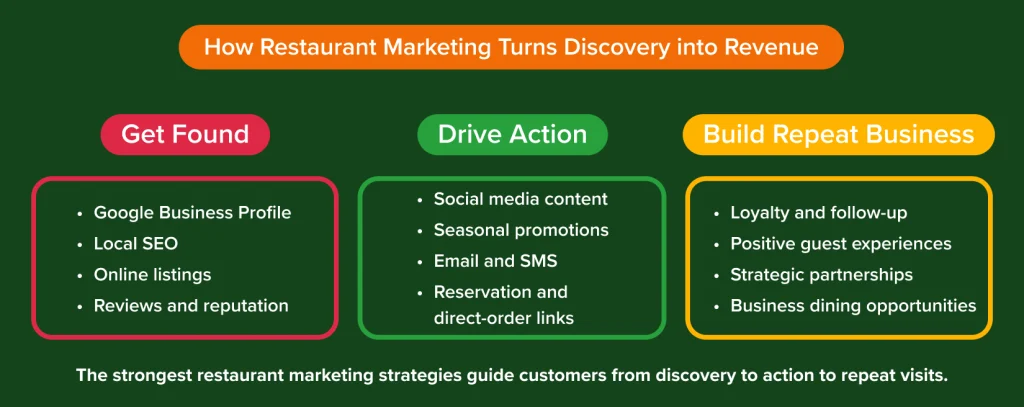
Being seen is only the first half of the job. The restaurant still has to give the customer a reason to act and a clear way to do it. Every additional click, confusing link, or unanswered question gives that person another chance to choose a competitor.
Create Engaging Social Media Content
Restaurant social media content should help people imagine the experience, not simply announce that the restaurant exists. Show signature dishes, limited-time menu items, chef expertise, celebrations, behind-the-scenes preparation, and the atmosphere guests can expect during different dayparts.
A useful content mix might include:
- Menu and beverage features
- Short videos showing food preparation or service
- Employee and chef stories
- Guest-generated content shared with permission
- Local community involvement
- Private dining, catering, or business dining capabilitie
Consistency matters more than posting constantly. Choose a realistic schedule and prioritize the platforms the restaurant’s customers use. Each post should also serve a purpose. Some content may build familiarity, while other posts should encourage a reservation, visit, or order through a clear call to action.
Build an Email and SMS Marketing Strategy
Email and text marketing allow restaurants to communicate directly with customers who have already expressed interest. Unlike an audience on a social platform, an opted-in contact list gives the restaurant more control over when and how it reaches guests.
Restaurants can grow their lists through loyalty programs, online ordering, reservations, event registrations, and website sign-up forms. Always explain what subscribers will receive and obtain the required consent, particularly for text messages.
Segmentation makes these messages more relevant. Rather than sending every promotion to every contact, restaurants can tailor communication based on location, ordering behavior, visit frequency, preferred daypart, or interests such as catering and private dining. A guest who regularly places takeout orders may respond to a direct-order offer, while a customer who booked a holiday party may be more interested in group dining options.
Promote Seasonal Offers and Events
Seasonal promotions give customers a timely reason to visit. Restaurants can build campaigns around holidays, sporting events, menu launches, local festivals, patio season, business travel periods, or slower dayparts.
The offer should align with an operational goal. A prix fixe menu could help simplify service during a high-volume holiday, while a weekday lunch package could generate demand during an underused daypart. Operators should consider ingredient availability, labor requirements, kitchen capacity, and profitability before launching a promotion.
Begin marketing early enough for customers to plan, especially for reservations and group events. Use coordinated messaging across the website, listings, social media, email, and in-store touchpoints so the offer is easy to recognize and act on.
Encourage Online Reservations and Direct Orders
Once a customer is interested, the path to conversion should be obvious. Place reservation and ordering buttons prominently on the website, keep menus easy to read on mobile devices, and minimize unnecessary steps during checkout or booking.
Direct ordering can help restaurants strengthen customer relationships and retain more control over the ordering experience. Operators can encourage customers to use direct channels by clearly linking to them and communicating relevant benefits, such as loyalty rewards, exclusive menu items, or easier order customization.
Review conversion points regularly. If customers visit an ordering page but abandon the process, test whether unclear fees, account requirements, slow page speed, or a complicated menu could be creating friction.
How to Build Strategic Partnerships That Grow Your Restaurant
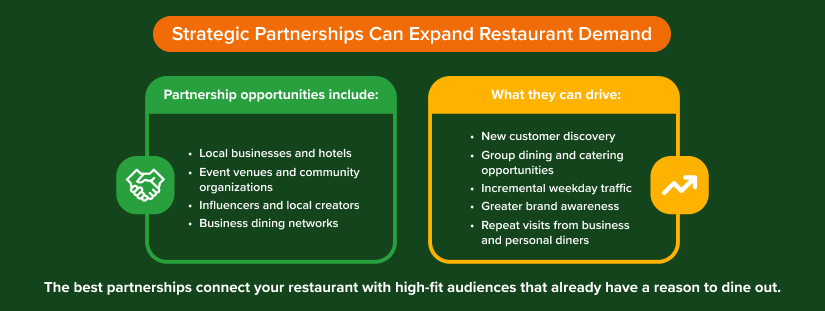
Restaurant growth does not have to come entirely from paid advertising. Strategic partnerships can introduce the restaurant to new audiences through organizations and people those customers already trust.
The most effective partnerships offer mutual value. Both parties should understand the audience, promotion plan, responsibilities, and intended outcome before the collaboration begins.
Partner with Local Businesses
Nearby businesses can become valuable referral partners. Hotels may recommend restaurants to guests, office managers may need catering or group dining options, and entertainment venues may want nearby pre-event or post-event dining recommendations.
Restaurants can develop packages, referral arrangements, cross-promotions, or exclusive experiences that benefit both businesses. For example, a restaurant and local theater might promote a dinner-and-show pairing, while a nearby hotel could feature the restaurant as a recommended dining option for business travelers.
Start with businesses whose customers naturally overlap with the restaurant’s target audience. A simple, well-supported partnership is often more effective than a large collection of relationships that receive little attention.
Participate in Community Events and Sponsorships
Community involvement can increase awareness while giving local customers another reason to support the restaurant. Opportunities may include food festivals, charity events, school fundraisers, neighborhood associations, sports sponsorships, and chamber of commerce programs.
Choose events that align with the restaurant’s values, audience, and capacity. Participation should include a plan for extending the value beyond the event itself. Collect permitted sign-ups, share event content, provide a trackable offer, or invite attendees to a future restaurant experience.
The goal is not simply to place a logo on a sign. It is to create a meaningful connection between the restaurant and the community it serves.
Collaborate with Local Influencers and Creators
Local creators can help restaurants reach specific communities through credible, experience-driven content. Audience relevance matters more than follower count. A smaller creator with strong engagement in the restaurant’s city or culinary niche may deliver more value than a larger account with little local connection.
Before beginning a partnership, review the creator’s audience, content quality, engagement, previous brand relationships, and disclosure practices. Define the requested deliverables, timeline, usage rights, compensation, and measures of success in writing.
Give creators enough information to represent the restaurant accurately while allowing them to speak naturally to their audience. Content that feels overly scripted can lose the trust that makes the partnership valuable.
Leverage Business Dining Networks
Business dining represents an important customer segment that restaurants may not consistently reach through consumer-focused marketing alone. Employees, executives, client-facing teams, and business travelers dine out for meetings, team meals, and work-related occasions. These visits can help restaurants build traffic during valuable weekday and off-peak periods.
Participating in a business dining network can connect restaurants with motivated diners who are already choosing where to spend company dining dollars. They may be looking for the right restaurant for a holiday gathering, a healthy dining option while traveling, or a fine dining experience for an important client meal. Dinova helps restaurants reach these business diners through a network of corporate clients and participating restaurant locations. This gives restaurant brands an additional channel for attracting incremental business dining traffic while building awareness among customers who may return for personal occasions.
Restaurants should make sure their business dining experience supports the needs of this audience. Reliable service, convenient locations, online reservations, receipt accuracy, group-friendly seating, and private or semi-private spaces can all influence where business diners choose to eat.
Restaurant Marketing Mistakes to Avoid
Even strong individual tactics can underperform when they are not supported by a clear strategy. Avoiding the following mistakes can help restaurants use their time and marketing budget more effectively.
Building an Inconsistent Brand
If the website presents an upscale experience but social content, photography, and in-store materials feel casual or disconnected, customers may not know what to expect. Inconsistency can also appear in smaller ways, such as using different restaurant descriptions, outdated logos, or conflicting menu information across platforms.
Create basic brand guidelines for voice, visual style, photography, and key messages. Every channel does not need identical content, but the restaurant should remain recognizable wherever customers encounter it.
Ignoring Local Search Opportunities
A restaurant can publish great social content and still miss customers who are actively searching nearby. Neglecting location pages, business listings, reviews, and neighborhood-specific keywords limits the restaurant’s ability to appear when purchase intent is high.
Make local search maintenance part of the regular marketing calendar. Review listings, links, photos, hours, and customer questions for every location, particularly before holidays and seasonal changes.
Using Too Many Marketing Channels Without a Strategy
Trying to maintain every social network, directory, advertising platform, and communication channel can stretch a restaurant team too thin. More channels do not automatically produce more customers.
Prioritize channels according to audience behavior and business goals. It is better to execute a few high-value programs consistently than to create a scattered presence that is rarely updated. Test one change at a time when possible so the team can understand what affected performance.
Failing to Measure Marketing Results
Likes and impressions may show that people saw a campaign, but they do not reveal whether the effort generated meaningful business. Operators should connect marketing activity to outcomes such as reservations, direct orders, offer redemptions, event inquiries, loyalty sign-ups, and revenue.
Use trackable links, unique promotional codes, reservation data, ordering reports, and customer relationship management tools to evaluate results. Compare performance with a relevant baseline and account for factors such as seasonality, holidays, weather, and local events.
Measurement does not need to be complicated. A small set of reliable metrics tied to a clear goal can provide more useful direction than a crowded dashboard with no defined purpose.
Final Thoughts
Effective restaurant marketing is not about chasing every trend or broadcasting the same promotion across every channel. It is about understanding the customers and dining occasions the restaurant wants to attract, showing up where those customers make decisions, and making the next step easy.
Local search, engaging content, direct communication, seasonal campaigns, and strategic partnerships can work together to create a stronger and more dependable source of demand. Business dining can also become a valuable part of that strategy by helping restaurants reach customers whose dining decisions are connected to meetings, travel, and company spending.
Dinova connects restaurants with business diners from leading companies, helping participating locations reach incremental traffic and build relationships that can extend beyond a single meal. Click here to learn more about joining the Dinova network.
Frequently Asked Questions
What Are the Best Marketing Strategies for Restaurants?
The best restaurant marketing strategies depend on the restaurant’s audience, location, concept, and goals. For many operations, the strongest mix includes local SEO, an optimized Google Business Profile, online review management, social media, email and SMS marketing, seasonal promotions, loyalty programs, business dining networks, and strategic partnerships. Each tactic should support a measurable goal, such as increasing reservations, direct orders, repeat visits, or traffic during a specific daypart.
How Much Should a Restaurant Spend on Marketing?
There is no percentage that fits every restaurant. A new location entering a competitive market may need a different investment than an established neighborhood restaurant with a strong base of regulars. Build the budget around defined goals and include the full cost of the work, including media, creative, software, promotions, and staff or agency time. Then compare that investment with the customers, revenue, or long-term value it produces.
Which Marketing Channels Deliver the Best ROI?
Channels tend to deliver a stronger return when they reach people with clear dining intent or an existing connection to the restaurant. Local search, email, SMS, loyalty communication, direct ordering, and retargeting may fit that description. Partnerships and business dining networks can also perform well because they introduce the restaurant to a defined audience. The answer should come from the restaurant’s own results, including acquisition cost, conversion, average check, and repeat behavior.
How Can Restaurants Attract More Local Customers?
Make sure nearby diners can find accurate information when they search. Maintain location pages and listings, respond to reviews, and publish content tied to the neighborhood and the occasions the restaurant serves. Local business partnerships, community events, relevant creators, and well-timed offers can introduce the restaurant to new people. Once they show interest, a clear menu, reservation link, or ordering path should make the decision simple.
How Can Strategic Partnerships Help Restaurants Grow?
Partnerships give restaurants access to audiences that another business, organization, creator, or network has already gathered. They can lead to referrals, group dining, catering, event traffic, brand awareness, and repeat visits. The most productive arrangements have an audience fit, a clear benefit for both sides, defined responsibilities, and a way to measure the result.
Which Restaurant Marketing Metrics Matter Most?
Use metrics that reflect the goal of the campaign. These may include reservation volume, direct orders, average check, offer redemptions, private dining inquiries, loyalty enrollment, customer acquisition cost, repeat visit rate, and revenue attributed to a channel. Website conversion, email clicks, and social engagement can help explain the path to purchase, but they should not replace the business outcome the campaign was designed to influence.
Andrew Parsons | 10.05.26