
Business Diner Tools:


Blogs
Corporate Dining vs. Restaurant Loyalty Programs Explained
Corporate dining programs help companies manage business meal spending and, in rebate-based programs, earn money back on eligible purchases. Restaurant loyalty programs generally reward individual customers for buying from a particular restaurant or brand. The biggest difference is whose goals the program serves: the company’s, the diner’s, or both.
That distinction matters when you’re responsible for a dining budget. An employee might earn a free appetizer while your organization gets little insight into where its meal dollars go. A corporate dining program addresses a different need: making business meals work harder for the business. Here’s how the two approaches compare, where each fits, and when they can work together.
What Is Corporate Dining?
Corporate dining covers meals purchased for business purposes, from a sandwich between sales calls to a catered training session or client dinner. In this article, a corporate dining program means an organized approach to those purchases, often through a network of participating restaurants. It does not mean an on-site employee cafeteria.
Depending on the provider, a program may connect eligible corporate card transactions with restaurant participation, generate rebates for the company, and provide reporting on dining activity. Some also offer employee rewards.
The practical goal is to get more value from meals employees already need to buy. That does not replace an expense policy. Your company still decides what is allowable, who can approve it, and how much employees can spend.
What Are Restaurant Loyalty Programs?
Restaurant loyalty programs reward customers for purchases at a restaurant, chain, or restaurant group. A diner typically creates an account, identifies themselves when ordering, and earns points, visits, or other credits toward future benefits.
Those benefits might include a birthday offer, a complimentary menu item, or a discount after reaching a spending threshold. Some programs offer tiers or limited-time promotions. The details vary, and not every purchase earns the same rewards.
For the restaurant, the purpose is straightforward: give people a reason to come back. For the diner, it is a way to get more from places they already enjoy. These programs are usually built around an individual customer relationship, not an employer’s dining budget or reporting needs.
Corporate Dining vs. Restaurant Loyalty Programs at a Glance
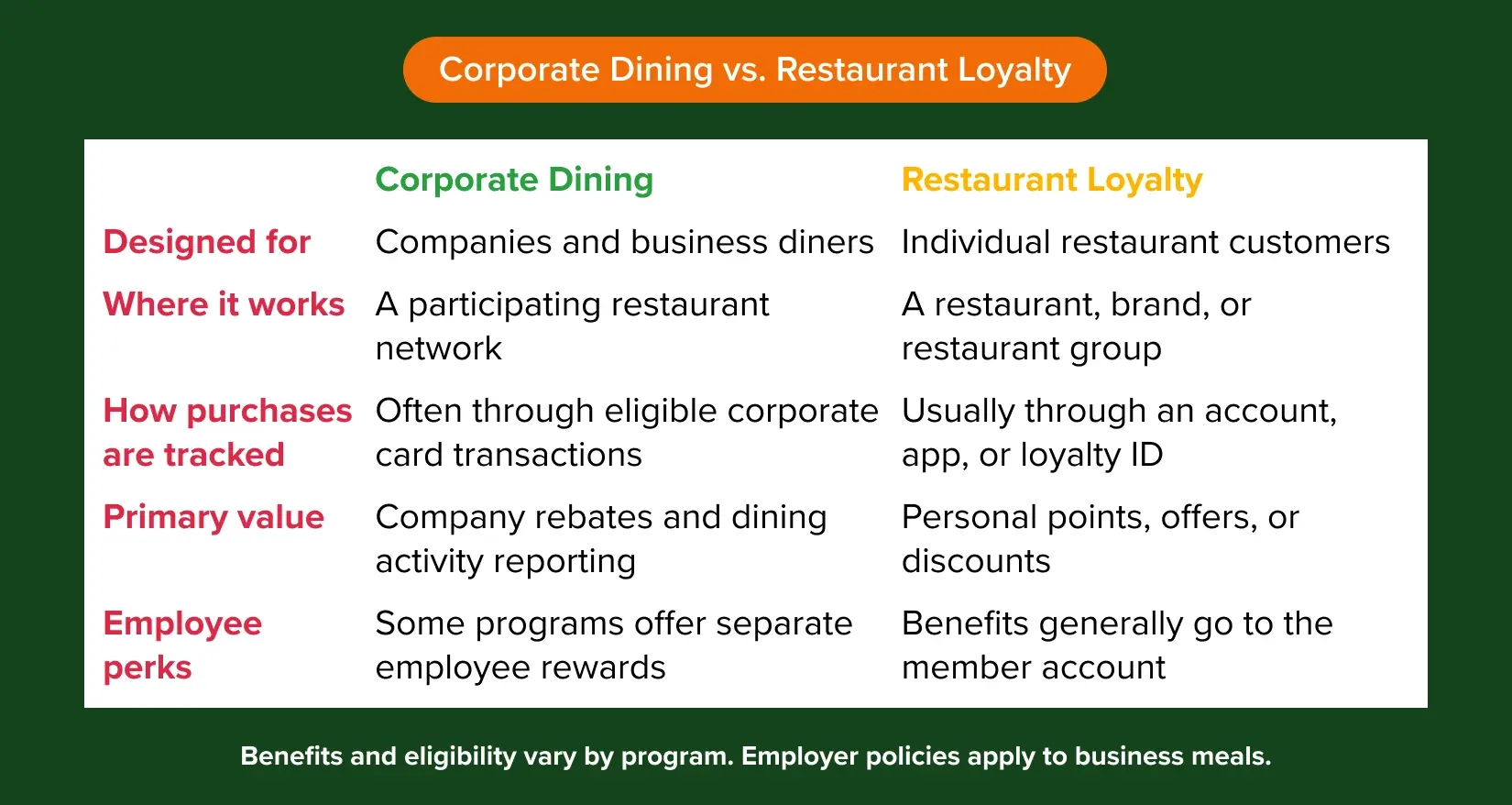
The distinction becomes clearer when you compare what each program is designed to accomplish. Corporate dining connects business meal purchases to organizational goals. Restaurant loyalty connects customer purchases to future visits.
The table describes common models, not universal rules. Corporate dining benefits depend on the provider and company agreement; restaurant rewards depend on each brand’s terms.
| Comparison | Corporate dining programs | Restaurant loyalty programs |
| Primary purpose | Support business dining and company value | Encourage customer return visits |
| Typical participant | An enrolled company and eligible employees | An individual customer |
| Where it works | A participating restaurant network | A restaurant, brand, or restaurant group |
| Purchase tracking | Often eligible corporate card transaction data | Usually an account, app, or loyalty identifier |
| Main benefit | Company rebates; sometimes employee rewards | Personal points, offers, or discounts |
| Management value | May include dining spend reporting | Usually not designed for company reporting |
| Key limitation | Eligibility and restaurant participation rules | Redemption rules and brand-specific benefits |
Neither approach automatically replaces the other. A business meal may qualify for both, provided the employer’s policy and each program’s terms allow it. The practical question is whether you need a company-level dining strategy, an individual perk, or both.
How Corporate Dining Works
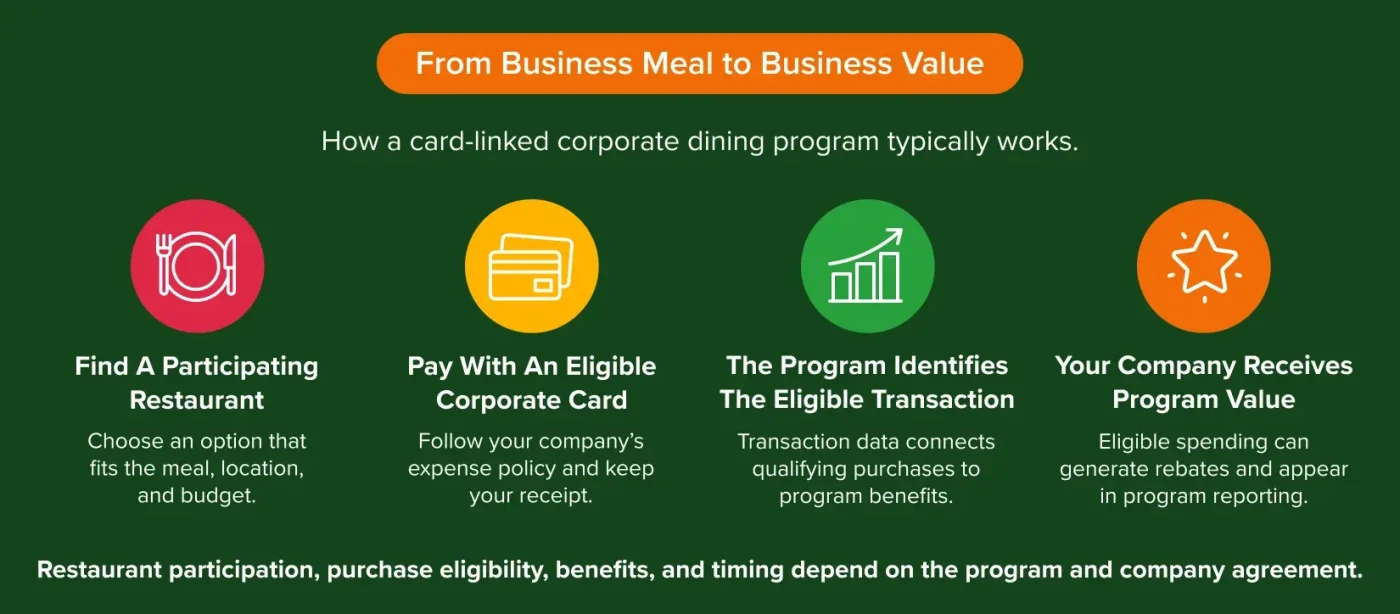
The process should fit into a normal business meal: find a participating restaurant, pay through the company’s approved method, and let eligible transactions generate program benefits. Here’s what that typically involves.
Choosing a Participating Restaurant
Start with the meal, not the reward. Is the location convenient? Can the restaurant accommodate your group, dietary needs, and budget? Then check whether it participates in your company’s dining program.
A provider’s restaurant search tool can help employees find options near an office, hotel, or client site. For catering or private dining, confirm availability and event requirements directly. Participation does not guarantee that every booking method or purchase qualifies, so check program rules before committing to a larger order.
Paying With a Corporate Card
In card-linked programs, employees pay with an eligible corporate card just as they would for another business expense. The program uses transaction data to identify qualifying purchases at participating restaurants.
That can reduce extra checkout steps, but it does not remove normal expense responsibilities. Employees still need to follow spending limits, retain receipts, and document the business purpose. A meal paid for with a personal card may not qualify, even if it is later reimbursed. Check eligibility before assuming a purchase will count.
Earning Corporate Rebates and Employee Rewards
Once an eligible transaction is identified, the program applies the benefits described in the company’s agreement. In a rebate-based model, the employer receives a rebate tied to qualifying restaurant spending. The amount and payment schedule depend on the arrangement.
Some programs also offer personal rewards for employees. Those are separate from the company rebate and may require enrollment or other qualifying steps.
Keep those two benefits distinct when explaining the program internally. The company’s return belongs in the business case; employee rewards can help encourage participation. Neither should be presented as a reason to spend more than the meal requires.
How Restaurant Loyalty Programs Work
Restaurant loyalty programs usually follow a familiar pattern: join, identify your account when buying, and collect benefits for future use. Earning and redemption rules can differ considerably from one brand to another.
Earning Points and Discounts
A restaurant might award points for each dollar spent, give credit for each visit, or offer a benefit after a certain number of purchases. Members may also receive targeted discounts or bonus-point offers.
The account generally needs to be linked to the purchase through an app, phone number, online login, or another identifier. Taxes, tips, alcohol, gift cards, and third-party orders may be treated differently. Employees should check the rules rather than assume the full amount of a business meal earns points.
Redeeming Rewards
Rewards are usually redeemed through the restaurant’s app, website, or ordering process. A member might exchange points for a menu item, apply an available discount, or claim an offer before it expires.
For business meals, there is another consideration: company policy. If a personal reward reduces the bill, the expense claim should reflect the amount actually paid. Employees should never submit the pre-discount total as though they paid it. When policy is unclear about personal rewards and business purchases, ask before redeeming them.
Encouraging Repeat Visits
A rewards balance gives customers a reason to choose the same restaurant again. So do member-only offers, reminders about expiring points, and progress toward the next reward. That repeat relationship is the heart of restaurant loyalty.
For an employer, though, another visit is not automatically a better purchasing decision. A familiar restaurant may be convenient, but it still needs to fit the meeting, location, and budget. Personal points should not turn an otherwise reasonable lunch into an unnecessary trip or a larger expense.
Who Gets the Rewards?
With restaurant loyalty, the benefit usually goes to the member account associated with the purchase. On a business meal, that might be the employee’s account, even though the company pays the bill. Whether employees may keep or use those rewards depends on employer policy and program terms.
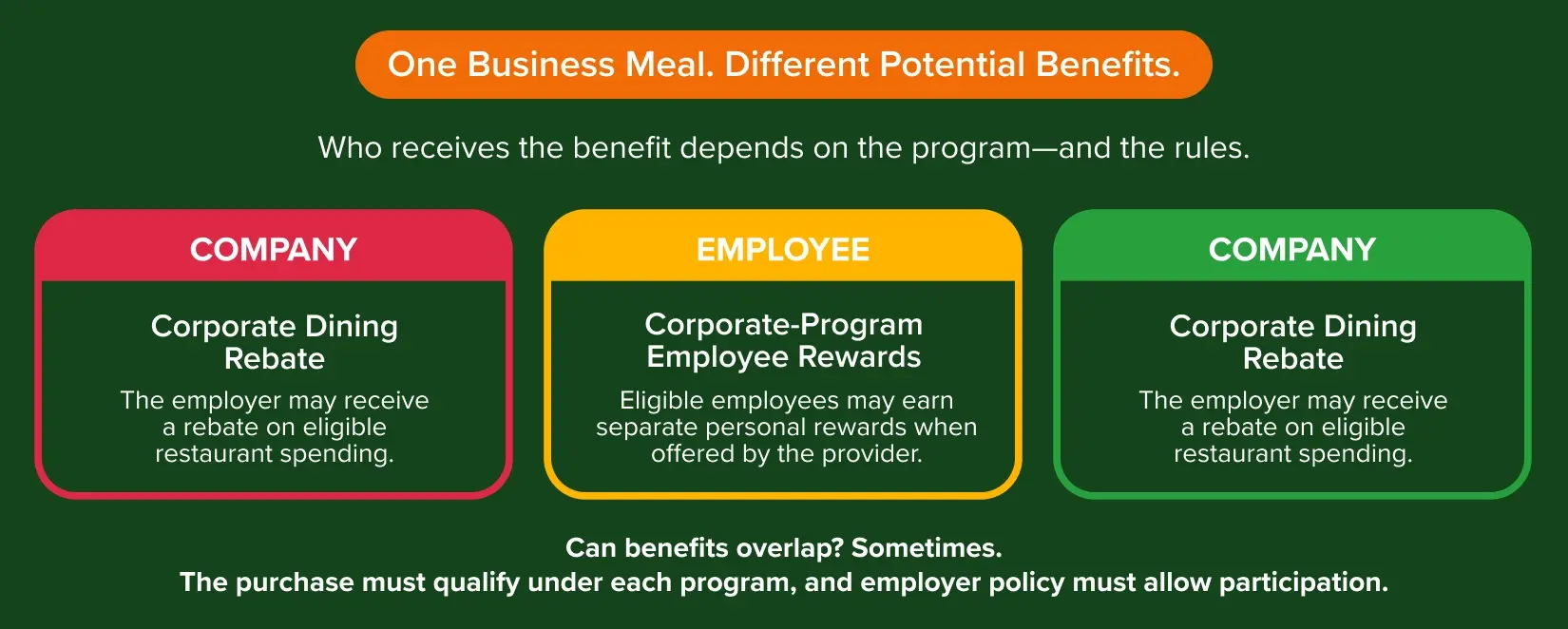
Corporate dining can create a different distribution of value. The company may receive rebates, while eligible employees may earn separate personal rewards if the provider offers them.
That makes ownership worth spelling out before launch. Explain which benefits belong to the company, which employees may retain, and how discounts affect expense reporting. Clear guidance avoids awkward conversations later, especially when a personal account is attached to a company-funded purchase.
Where Each Program Fits Best
Neither approach needs to cover every meal. The better fit depends on who is paying, why the meal is happening, and whether the goal is company savings or personal value.
Business Meals, Travel, and Client Dining
Corporate dining is a natural fit when meals are a recurring business expense rather than an occasional purchase. Think travel meals, team lunches, client dinners, catering, and eligible private events.
For a travel or procurement manager, the advantage is consistency across many employees and locations. Instead of relying on scattered restaurant offers, the organization has a framework for directing eligible spending and measuring program results.
Restaurant coverage still matters. A network needs to offer practical choices where employees actually work and travel. A generous benefit has limited value if using it means driving across town or choosing an unsuitable venue.
Personal Dining and Repeat Restaurant Visits
Restaurant loyalty often makes the most sense when someone regularly visits the same places with their own money. A commuter buying coffee near the office or a family ordering Friday takeout can earn benefits without involving a company program.
The appeal is simple: rewards follow an existing habit. There is little reason to change a sensible routine if the restaurant offers something useful in return.
The caution is just as simple. Buying more to reach a reward can erase its value. Check redemption thresholds and expiration dates, and treat a free item as a bonus—not a reason to stretch the budget.
Pros and Cons of Each
Both approaches can deliver value, but they solve different problems. Compare their practical benefits and limitations before deciding what belongs in your company’s dining strategy or an employee’s personal routine.
Corporate Dining
The main advantage is company-level value from eligible business meals. Rebates can offset some dining costs, while reporting can help teams understand program participation and qualifying spend. Where employee rewards are available, they provide another reason to choose participating restaurants.
The limitations are mostly about fit and adoption. Benefits depend on restaurant coverage, eligible payment methods, and the program’s commercial terms. Employees also need clear instructions and convenient choices.
A program is not a substitute for expense controls, and reporting may not capture every meal or provide item-level detail. Evaluate the eligible spend, likely participation, administrative effort, and net financial return—not just the headline benefit.
Restaurant Loyalty Programs
Restaurant loyalty can be easy to join and useful for frequent customers. Relevant offers and achievable rewards may add value to purchases a diner would make anyway. Restaurants benefit when those incentives encourage another visit.
The trade-offs are fragmented accounts, changing offers, and redemption restrictions. Points may expire, and rewards at one brand usually cannot be used at another. Keeping track of multiple programs can become a chore.
From a corporate perspective, personal rewards also provide limited budget oversight. They do not generally create a company rebate or a consolidated view of business dining. That does not make them ineffective; it makes them a different tool.
Who Should Choose Each Type of Loyalty Program?
Start with the decision you need to make. Are you managing company meal spending, or choosing how to get more from personal restaurant visits? The answer points toward the appropriate approach.
Go With Corporate Dining If
Consider corporate dining if your organization has recurring meal expenses and wants a more deliberate way to manage them. It is particularly worth evaluating when employees already use corporate cards and dine across multiple locations.
Before choosing a provider, compare restaurant coverage against actual spending patterns. Ask how transactions qualify, what reporting is available, how rebates are calculated, and what implementation requires.
Then test the employee experience. People need to find a suitable restaurant quickly. A program that fits ordinary workdays is more useful than one that looks attractive only on paper.
A Restaurant Loyalty Program Makes More Sense If
Choose restaurant loyalty when the primary goal is personal value at places you already visit. It works especially well when the rewards are easy to understand, the earning threshold is realistic, and the offers match your habits.
For an employer with very occasional meal expenses, a corporate program may not be the immediate priority. Even then, personal restaurant rewards should not be mistaken for a company savings strategy.
Employees using loyalty accounts on business meals should follow employer policy. The restaurant’s permission to earn points does not, by itself, establish the company’s approval.
Take the Next Step With a Corporate Dining Program
If your goal is company-level value from business meals, Dinova offers a preferred business dining program connecting corporations with 24,000-plus restaurants across the U.S. and Canada. Employees pay full price with eligible corporate cards; transaction matching supports corporate rebates without restaurant POS integration. Eligible employees can also earn personal rewards through myDinova Rewards.
Start by reviewing where your employees dine and how they pay. Then talk with Dinova about restaurant coverage, reporting, and program requirements. The aim is straightforward: make business meals count without making them harder to manage.
Click here to contact Dinova and learn how business dining can work for you.
FAQs
Is corporate dining a type of restaurant loyalty program?
Not in the usual consumer sense. Corporate dining programs organize business meal spending and may deliver company rebates, reporting, and employee rewards. Restaurant loyalty programs generally reward individual customers for repeat purchases. There is overlap in encouraging restaurant choice, but the primary customer and business purpose are different.
How does corporate dining differ from a restaurant loyalty program?
Corporate dining focuses on company-funded meals and organizational value, often through a restaurant network and eligible corporate card spending. Restaurant loyalty focuses on a customer’s relationship with a restaurant or brand. Corporate rebates and personal restaurant points are different benefits, even when the same meal could qualify for both.
Who pays for the rewards in a restaurant loyalty program?
The restaurant or brand generally funds the rewards as a marketing expense. A program operator or partner may share costs under some arrangements. Restaurants offer these benefits because they expect stronger customer relationships and repeat purchases to justify the cost. Funding details vary by program and commercial agreement.
How does a company benefit from corporate dining?
Depending on the provider and agreement, a company can receive rebates on eligible dining purchases and reporting that helps it understand program activity. A participating restaurant network can also guide employee choices. Results depend on eligible spending, coverage, and adoption; the program does not replace expense policies or approvals.
Can employees still use restaurant loyalty apps on business meals?
Sometimes. Both the restaurant’s terms and the employer’s policy must allow it. Check whether the purchase channel and payment method qualify, whether benefits can be combined, and how discounts affect reimbursement. Do not assume that earning personal points changes the corporate card requirement or makes an expense allowable.
Can a restaurant be part of both?
Yes. A restaurant can participate in a corporate dining network while offering its own customer loyalty program. The programs serve different purposes: reaching business diners and encouraging customer return visits. Whether one purchase qualifies for benefits under both depends on each program’s rules and the diner’s employer policy.